
Condo corporations have a duty to enforce their rules. In fact, they can get into trouble if they don’t. But every now and then a case comes along that reminds us that doing the right thing is not always possible if you don’t have the governing documents to back it up.
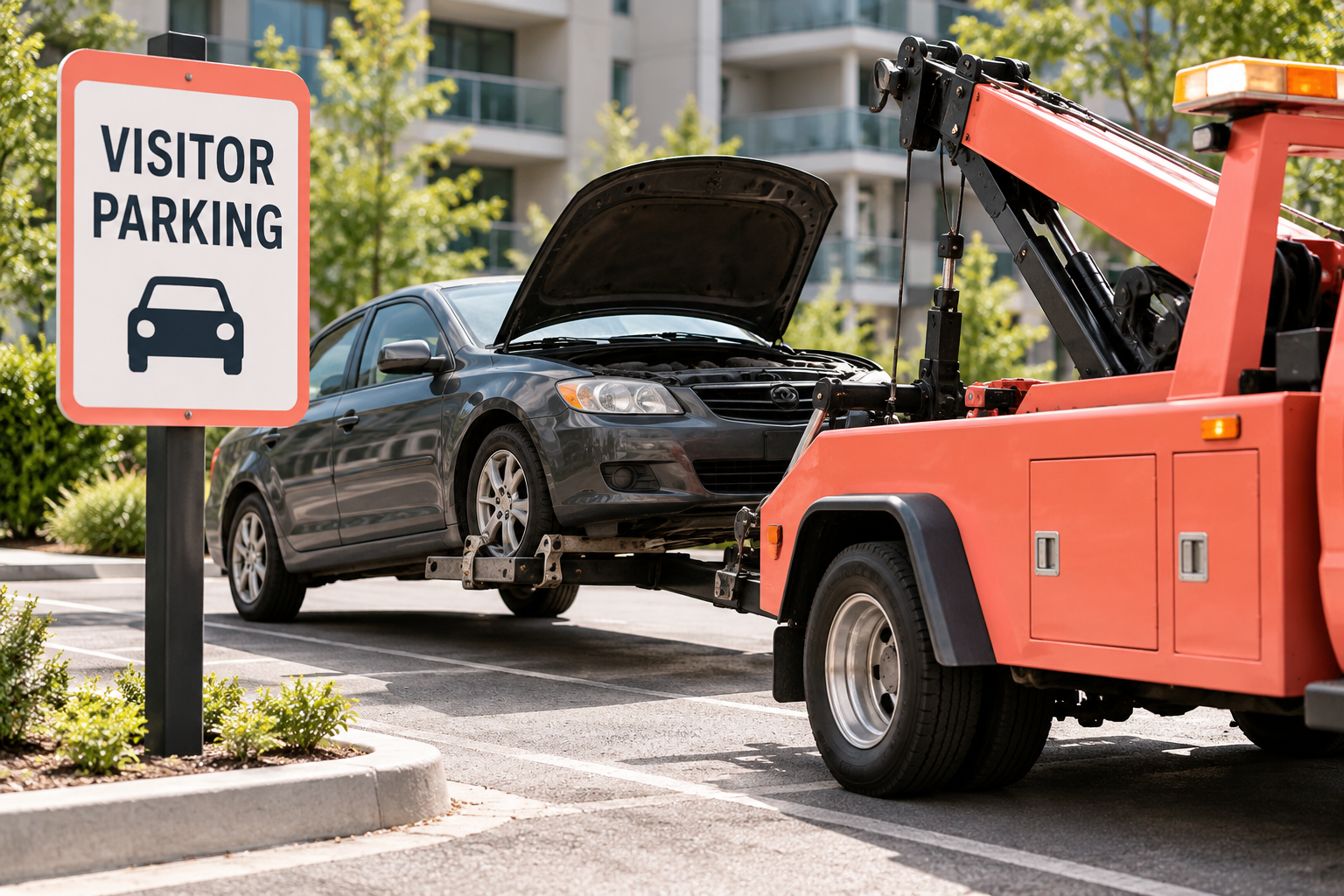
This is the story of a wrecked car, a two-week stay in visitor parking, and a condo that did not have the rule to tow it.
Key Takeaways before condos can tow a car
- Check your condo rules before you tow a car
- Check if your rules prohibit the parking of inoperable or damaged vehicles
- Check if the vehicle has a valid parking permit or is otherwise entitled to be there
- Ensure you give proper notice
- Condos must ensure parking rules are consistent across declarations, by-laws, rules, and shared facilities agreements
- The CAT will closely examine the precise wording of parking rules before upholding towing decisions.
- Even where an owner’s conduct appears unreasonable, the corporation may still lose if enforcement is not authorized by the governing documents.
- Boards should periodically review visitor parking rules to identify gaps and ambiguities.
The Facts of this case
This wasn’t a case about a visitor who parked overnight without a permit.
This was a case about a vehicle with a badly damaged front end that was towed into the visitor’s parking space because it could not be driven. The vehicle then sat in visitor parking for approximately two weeks with a handwritten sign in the windshield : “Awaiting tow.”
According to the evidence, the vehicle belonged to an owner’s friend. There was a debate whether this friend lived at the corporation (which would have disqualified them from parking in visitor parking) but there was insufficient evidence on this front.
Visitor Parking or Vehicle Storage?
The rules only allowed visitors to park up to 10 days in visitor parking. But the owner appears to “skirt around this rule” (I’m using the CAT’s language) by obtaining a series of visitor parking permits on the basis that she owned two units. On this, the CAT observed that, even if the car owner was a visitor, it is unlikely that he was visiting both units…
Still, based on this series of permit, the vehicle remained parked for weeks, while its owner allegedly planned to have it taken to a mechanic at some later date – hardly a case of someone visiting a unit.
The Corporation's Problem
The corporation relied on its rule requiring vehicles on the condo property to be in “roadworthy condition.” That sounds straightforward enough.
Except the visitor parking area in question was governed by a separate set of Shared Facilities Rules. Those rules also required overnight permits and allowed towing in certain circumstances, but these rules did not contain any requirement that vehicles be roadworthy.
That distinction proved fatal.
- The vehicle was not roadworthy.
- The vehicle was effectively being stored in visitor parking.
- It is unlikely that the vehicle owner was visiting a unit owner for 2 weeks.
Yet none of that mattered.
Why?
Because condo corporations cannot enforce what they wish their rules said. They can only enforce what their rules actually say.
The CAT appeared to unreluctantly rule in favour of the owner:
“The corporation’s enforcement action in having Ms. D’Souza’s vehicle towed appears to be inherently reasonable given the evidence that the vehicle was not roadworthy. In effect, it had been being stored in a visitor parking spot for approximately two weeks. However, the Shared Facilities Rules do not state that vehicles parked in the visitor parking areas must be roadworthy.”
Not entirely a win for the owner
The owner sought almost $4,500 consisting of a towing charge plus 46 days of storage fees. In the end, the Tribunal awarded just $610.
Why the gap?
Because the Tribunal found that the applicant had failed to mitigate her damages.
The evidence showed that after learning the vehicle had been towed, she largely waited for the corporation to decide whether it would pay for its release instead of paying the charges and retrieving the vehicle promptly. The result was a storage bill that grew and grew.
The Tribunal concluded it would be unreasonable to make the corporation responsible for weeks of accumulating storage charges and limited recovery to the towing fee plus three days of storage.
The owner also did not recover her Tribunal fees on the basis of her conduct during the proceeding, including delays, missed deadlines, late filings, repeated extension requests, and even failing to appear on time for scheduled testimony.
The Real Lesson
The owner’s conduct struck the Tribunal as questionable. The decision repeatedly highlights facts suggesting that visitor parking was being used for something it was never intended to be used for: the storage of an inoperable vehicle.
Yet the corporation still lost because it attempted to enforce a restriction that did not actually exist in the governing rules applicable to that specific parking area.
That is the takeaway for boards and managers:
When enforcing parking rules, being right on the facts is not enough. Being frustrated is not enough. Even acting reasonably may not be enough. The authority to enforce must be found in the declaration, by-laws, rules, or other governing documents.
For condo corporations, the Chauhan case serves as a useful reminder: Don’t tow first and asking questions later! Make sure the rule you are enforcing actually applies.
And as always, reach out to your favourite condo lawyer if you need guidance on how to improve or interpret your rules.