


Remembering a Canadian Piper.
The battle of the Somme began 110 years ago, on July 1, 1916.
By 1916, the Western Front had become a massive stalemate with German forces occupying large areas of France and Belgium. Determined to break the deadlock, the British and French launched a massive offensive along the Somme River.
What followed would become one of the bloodiest battles in human history. The British Army suffered more than 57,000 casualties, including 19,240 lost souls… in the first 24 hours. The battle would rage for 141 days.
Canada Answered the Call
Canada, who had entered the war when Britain did, raised its own expeditionary force and sent troops to fight as Canadian formations under British command. They arrived at the Somme in late August and early September.
For months, the battlefield was a living nightmare of mud, blood and shattered bodies. Soldiers huddled in waterlogged trenches, surrounded by the relentless thunder of artillery and the deadly rattle of machine guns. The deafening roar of war drowned out everything but fear.
Yet, on October 8, 1916, somewhere in a muddy field in northern France, an unexpected sound rose above the deafening explosions of artillery shells. It was the sound of Canadian bagpipes. The soldier playing them was James Cleland Richardson.
A young Canadian, far from home
James Richardson was born in Scotland in 1895. He immigrated to Canada as a teenager, with his family who settled in British Columbia. Shortly after his arrival, he joined and served as a piper in the 72nd Seaforth Highlanders of Canada.
When war broke out in 1914, Richardson enlisted in the Canadian Expeditionary Force and became a piper with the 16th Battalion (Canadian Scottish). Shortly thereafter, he was deployed to the front. By October 1916, he had already spent more than a year and a half overseas.
The Sound of Courage
On a fateful October 8, Richardson’s battalion was ordered to attack the Regina Trench, a heavily defended German position. What awaited them was a deadly maze of trenches, barbed wire and devastating machine gun fire.
As men fell wounded or dead, the assault began to falter. With his comrades trapped in the shell holes of no man’s land, Richardson turned to an unlikely weapon.
In an extraordinary act of courage, he tucked his bagpipes under his arm, climbed out of the safety of the trenches and, according to historical accounts, walked up and down the wire entanglements, fully exposed to German gunfire, while playing his pipes.
At first, the notes were faint, barely audible above the chaos of battle. But as he continued to play, the melody rose above the gunfire, growing louder and clearer. For ten extraordinary minutes, amid the thunder of artillery and the rattle of machine guns, an unmistakable sound carried across the field. Not orders shouted by officers, not another artillery barrage. It was a young Canadian reminding his comrades, through music, that they were not alone.
His citation for the Victoria Cross states:
“The effect was instantaneous. Inspired by his splendid example, the company rushed the wire with such fury and determination that the obstacle was overcome and the position captured”.
In the face of overwhelming danger, Richardson had given them the courage to advance. Not with orders, not with bullets, but with music.
Victoria Cross
For his extraordinary courage, Richardson would be awarded the Victoria Cross, the highest decoration for gallantry in the face of the enemy. But he would not live to receive it.
Later that day, while helping escort a wounded comrade and German prisoners away from the battlefield, he realized he had left his bagpipes some 200 yards behind. His fellow soldiers urged him against returning but Richardson turned back to retrieve his precious instrument.
He was never seen alive again. He was seven weeks away from his 21st birthday.
Presumed dead, his remains were located four years later, in 1920. He is now buried in Plot III, Row F, Grave 36 at the Adanac Military Cemetery near Albert, France.
His bagpipes finally came home
For 90 years, Richardson’s bagpipes were believed lost.
What was not known is that, in 1917, a British Army chaplain had recovered a set of bagpipes from the battlefield and brought them to Scotland. The instrument eventually found its way to a Scottish school, where it remained for generations. Its remarkable history was largely forgotten until the early 2000s, when the bagpipes were identified as Richardson’s, which lead to their return to Canada.
Twenty years ago nearly to the day, on November 8, 2006, Richardson’s bagpipes were formally returned to Canada, 90 years after his death. Today, they are preserved at the British Columbia Legislative Assembly in Victoria.
Richardson never came back to Canada, but his bagpipes did.
Remembrance Day
By the time the Battle of the Somme ended, more than one million soldiers had been killed, wounded or reported missing. Of those, approximately 300,000 lost their lives. Canada alone suffered more than 24,000 casualties.
James Cleland Richardson’s bagpipes are silent now. But the courage they inspired still echoes, 110 years later.
Let us remember the families who waited, the lives that were never lived, and the extraordinary price paid for the peace and freedoms that are now entrusted in us.
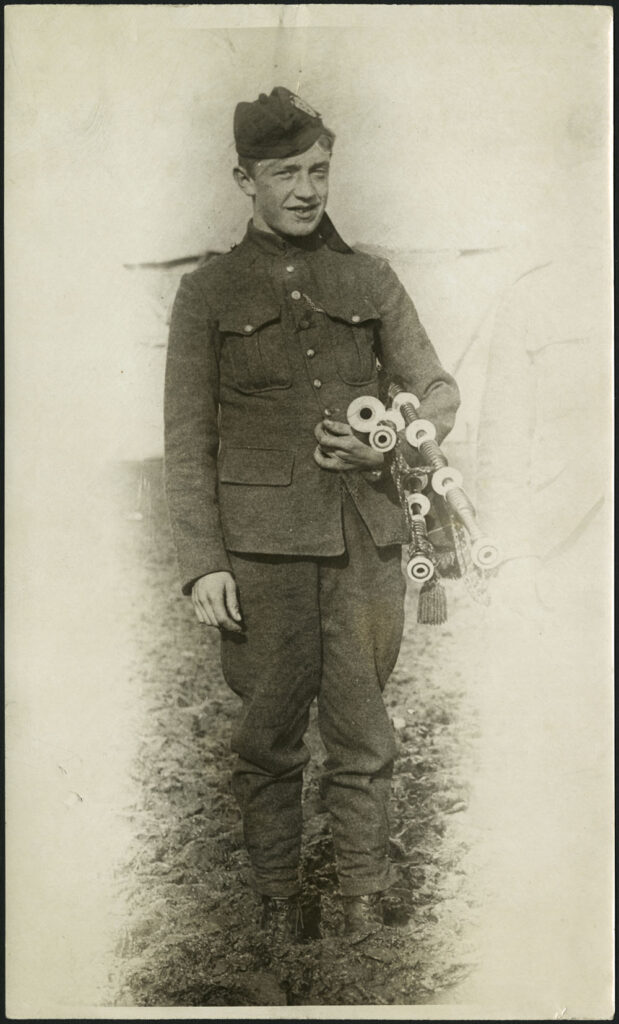
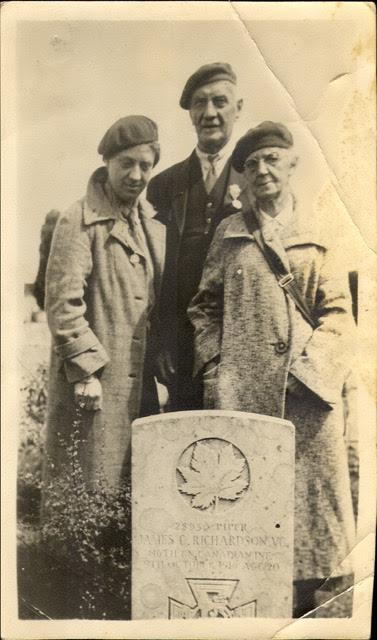
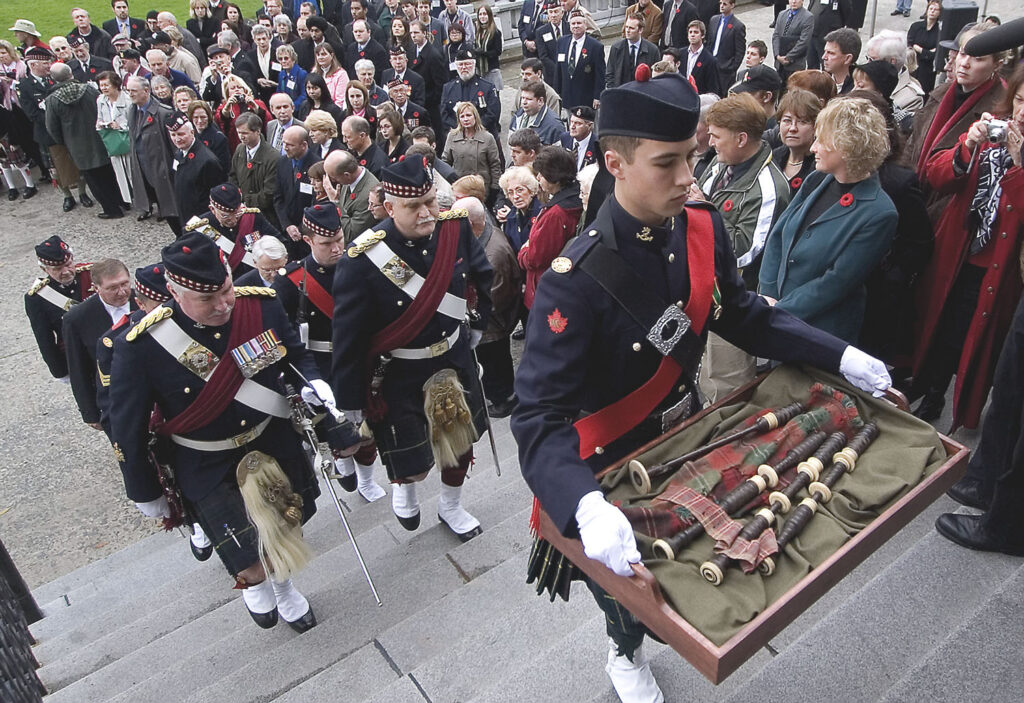
James Cleland Richardson. To the right, James’ parents and sister visiting his gravesite in 1936. Below, the repatriation of his bagpipes in British Columbia, in 2006 (Photo Victoria Times, Victoria, British Columbia).